

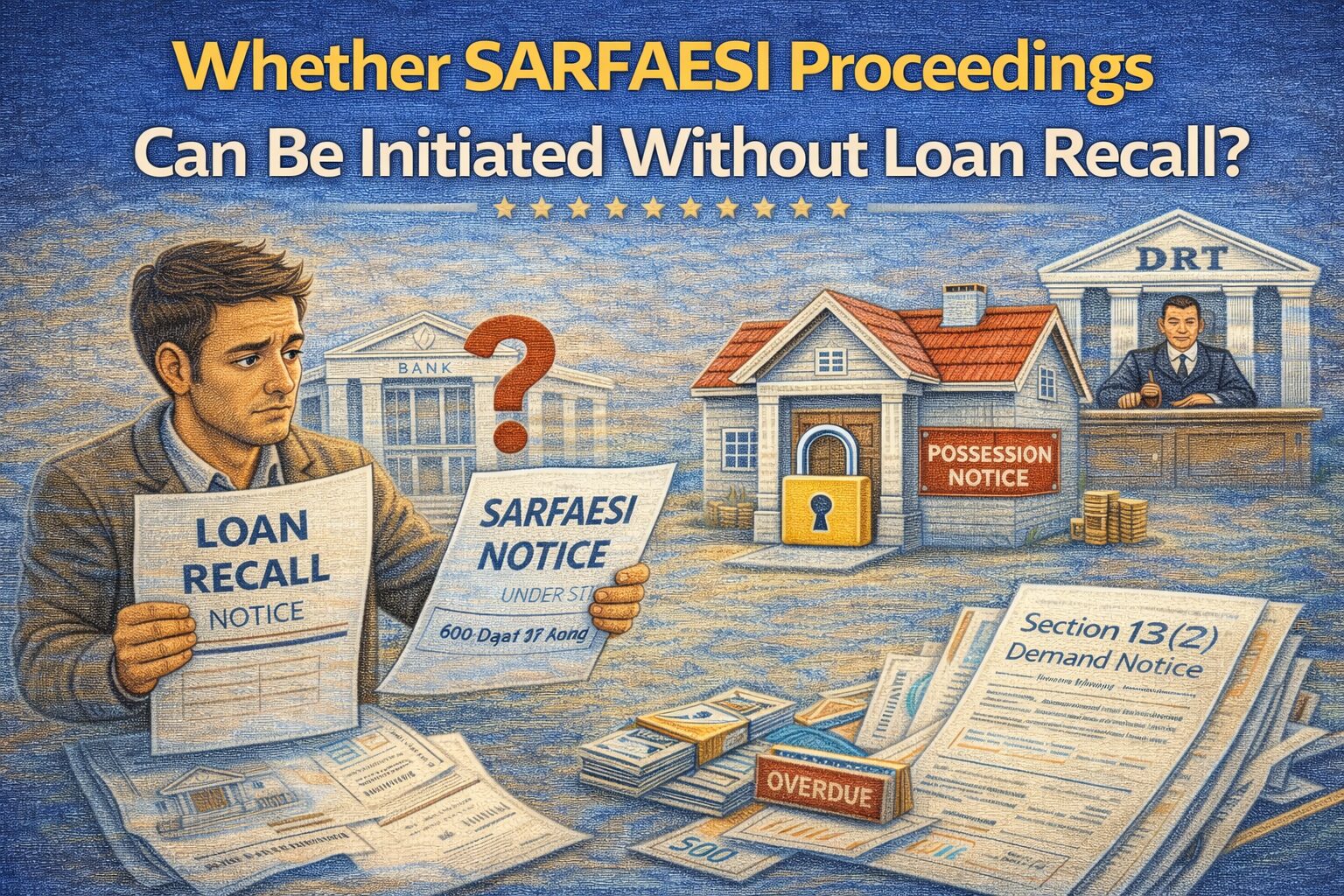
A frequent question raised by borrowers is whether a bank can initiate SARFAESI proceedings without first recalling the loan. Many assume that unless the bank issues a separate loan recall notice, SARFAESI action is illegal. This assumption often leads to misplaced confidence and delayed legal action.
This article explains the correct legal position on loan recall and its relationship with SARFAESI proceedings.
Table of Contents
ToggleWhat Is a Loan Recall?
A loan recall is a demand by the bank requiring the borrower to:
Repay the entire outstanding loan amount immediately, and
Treat the loan agreement as accelerated due to default
Loan recall is generally governed by:
Loan agreement terms
Banking practice and RBI guidelines
Is Loan Recall Mandatory Before SARFAESI Action?
Short Answer: No
👉 SARFAESI proceedings can be initiated even without issuing a separate loan recall notice, provided statutory conditions under the SARFAESI Act are fulfilled.
The SARFAESI Act does not mandate a prior loan recall as a condition precedent.
Statutory Requirement Under SARFAESI
Under the SARFAESI Act, the only mandatory pre-conditions are:
The loan must be a secured loan
The account must be classified as a Non-Performing Asset (NPA)
A 60-day demand notice under Section 13(2) must be issued
Once these conditions are met, SARFAESI action can lawfully proceed.
Section 13(2) Notice vs Loan Recall Notice
A Section 13(2) SARFAESI notice itself operates as a statutory recall for SARFAESI purposes.
The notice:
Demands payment of the entire outstanding dues
Gives 60 days’ time
Warns of enforcement under Section 13(4)
👉 Therefore, a separate contractual recall notice is not legally required.
Judicial View on Loan Recall & SARFAESI
Courts have consistently held that:
SARFAESI is a special statute
Statutory notice under Section 13(2) is sufficient
Absence of a prior loan recall does not invalidate SARFAESI action
The focus is on statutory compliance, not contractual formalities.
When Loan Recall Becomes Relevant
While not mandatory, loan recall may become relevant in:
Contractual disputes
Civil recovery suits
Insolvency proceedings
Interpretation of loan acceleration clauses
However, for SARFAESI enforcement, recall is not a statutory requirement.
Common Misconceptions Among Borrowers
❌ Bank must first recall the loan
❌ SARFAESI without recall is illegal
❌ Recall notice and Section 13(2) notice are the same
✔ Correct position:
Section 13(2) notice is sufficient
Loan recall is not mandatory under SARFAESI
Can Borrowers Challenge SARFAESI on This Ground Alone?
No.
A SARFAESI action cannot be set aside solely because:
No separate loan recall notice was issued
However, borrowers can succeed if they establish:
No valid NPA classification
Defective Section 13(2) notice
Non-consideration of objections
Lack of jurisdiction
Practical Advice for Borrowers
Do not rely on absence of loan recall as a defence
Focus on procedural and statutory violations
Respond properly to Section 13(2) notice
Act promptly before possession stage
Approach DRT at the correct stage
Conclusion
SARFAESI proceedings can be lawfully initiated without issuing a separate loan recall notice.
The SARFAESI Act is a self-contained statutory mechanism, and compliance with Section 13(2) is sufficient to trigger enforcement. Borrowers should therefore focus on substantive legal safeguards, not technical misconceptions.
FAQs
Q. Is loan recall compulsory before SARFAESI action?
No. It is not required under the SARFAESI Act.
Q. Does Section 13(2) notice amount to recall?
Yes, for SARFAESI purposes, it functions as a statutory recall.
Q. Can SARFAESI be challenged only on the ground of no recall?
No. That ground alone is insufficient.