

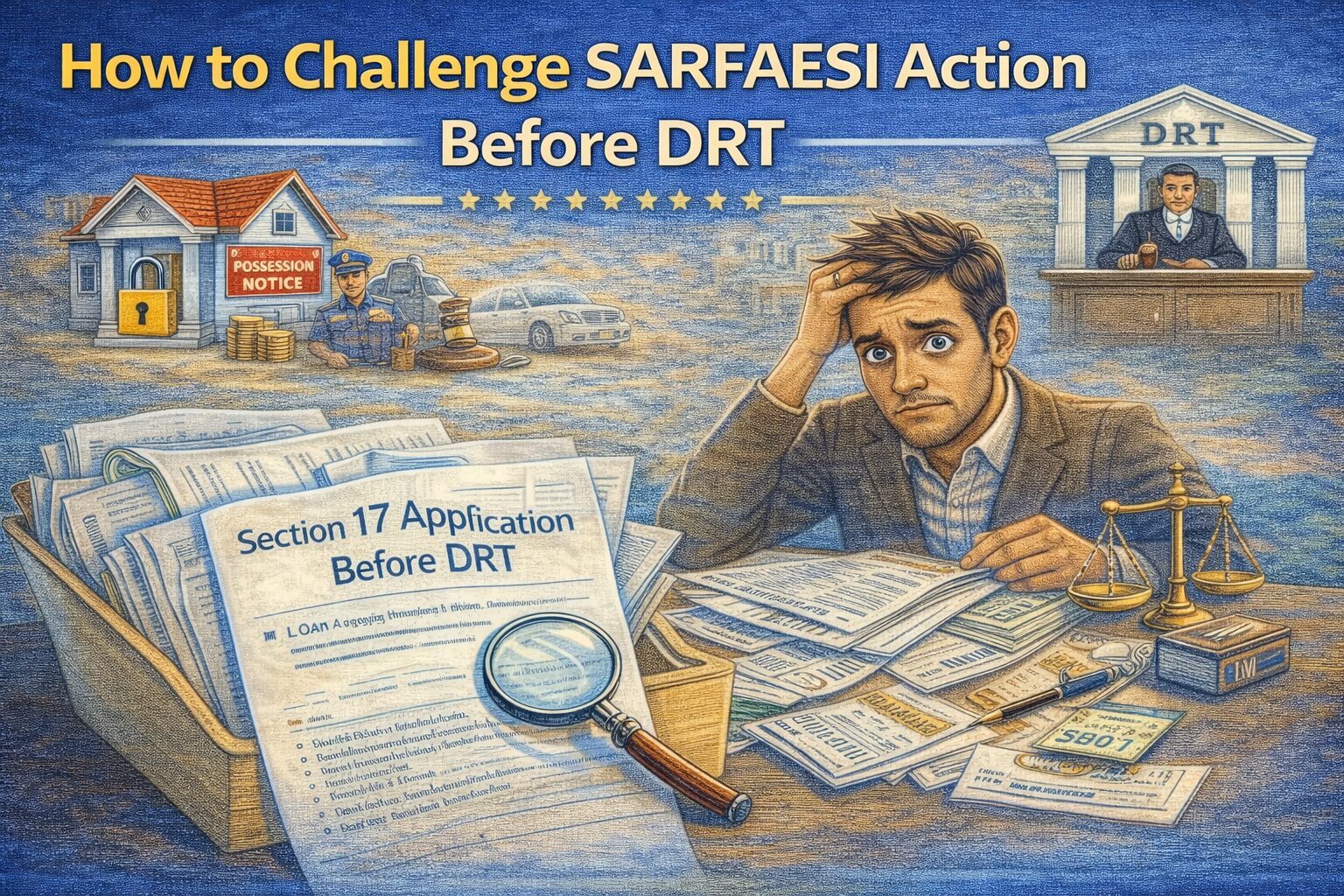
The Debt Recovery Tribunal (DRT) is the primary and statutory forum for borrowers to challenge illegal or arbitrary actions taken by banks under the SARFAESI Act, 2002. While SARFAESI grants wide enforcement powers to secured creditors, those powers are strictly regulated, and any deviation can be effectively challenged before the DRT.
This article explains when, how, and on what grounds SARFA registeration_action can be challenged before the DRT, in a step-by-step manner.
Table of Contents
ToggleWhat Is the Remedy Before DRT Under SARFAESI?
The remedy to challenge SARFAESI action lies under Section 17 of the SARFAESI Act.
A borrower (or any aggrieved person) can approach the DRT after the bank takes measures under Section 13(4), such as:
Taking possession of secured assets
Taking over management
Appointing a manager
Issuing sale or auction notice
⚠️ A Section 13(2) demand notice alone cannot be challenged before DRT.
Who Can Approach the DRT?
The following persons can file an application before DRT:
Borrower
Guarantor
Co-owner of secured property
Any person aggrieved by SARFAESI action
Time Limit to Approach DRT
⏳ An application must be filed within 45 days from the date on which the SARFAESI measure under Section 13(4) is taken.
Delay is rarely condoned. Limitation is strictly enforced.
Step-by-Step Procedure to Challenge SARFAESI Action Before DRT
Step 1: Identify the SARFAESI Measure Challenged
First, determine the exact action being challenged, such as:
Possession notice
Section 14 order
Auction notice
Sale confirmation
DRT examines the legality of measures, not the loan transaction itself.
Step 2: Collect Relevant Documents
Essential documents include:
Loan agreement & security documents
Section 13(2) demand notice
Proof of service
Objections filed under Section 13(3A)
Possession notice / auction notice
Section 14 order (if any)
Incomplete documentation weakens the case.
Step 3: Draft Application Under Section 17
The application should clearly plead:
Jurisdictional facts
Timeline of SARFAESI proceedings
Specific statutory violations
Grounds for setting aside action
Prayer for interim relief
Vague or emotional pleadings are ineffective.
Step 4: Grounds Commonly Accepted by DRT
Borrowers succeed before DRT on grounds such as:
No valid NPA classification
Defective or non-service of Section 13(2) notice
Non-consideration of objections under Section 13(3A)
SARFAESI invoked for unsecured loan
Agricultural land proceeded against
Illegal possession or auction
Mechanical Section 14 order
Step 5: Seek Interim Relief
Along with the main application, borrowers should seek:
Stay of further SARFAESI proceedings
Protection against physical possession
Stay of auction
⚠️ Delay in seeking interim relief can make the application infructuous.
Step 6: Hearing Before DRT
DRT proceedings are:
Summary in nature
Evidence-based on documents
Focused on statutory compliance
DRT does not normally:
Recalculate loan accounts
Enter into contractual disputes
Step 7: Powers of DRT Under SARFAESI
DRT can:
Set aside illegal SARFAESI measures
Restore possession to borrower
Declare auction void
Grant interim and final relief
What DRT Cannot Do
DRT generally cannot:
Grant long-term repayment schedules
Rewrite loan contracts
Enter into equity-based settlements
Its role is corrective, not commercial.
Appeal Against DRT Order
An appeal lies to the Debt Recovery Appellate Tribunal (DRAT) under Section 18, subject to:
Mandatory pre-deposit (usually 50%, reducible to 25%)
Common Mistakes Borrowers Make Before DRT
❌ Filing beyond limitation
❌ Approaching wrong DRT
❌ Not seeking interim relief
❌ Raising irrelevant disputes
❌ Relying only on sympathy
Practical Advice for Borrowers
Act immediately after possession notice
Do not wait for physical dispossession
Focus on procedural violations
Preserve all documents
Engage experienced legal counsel
Conclusion
Challenging SARFAESI action before the DRT is a statutory right, but it is also a time-sensitive and procedure-driven remedy. Borrowers who understand the correct stage, grounds, and process can effectively protect their property and rights. Delay, ignorance, or procedural lapses often prove fatal.
FAQs
Q. Can SARFAESI action be challenged before DRT without possession?
No. DRT remedy arises only after action under Section 13(4).
Q. Can auction be stayed by DRT?
Yes, if serious violations are shown.
Q. Is DRT the only forum?
Yes, except in rare cases of jurisdictional abuse where High Courts intervene.