

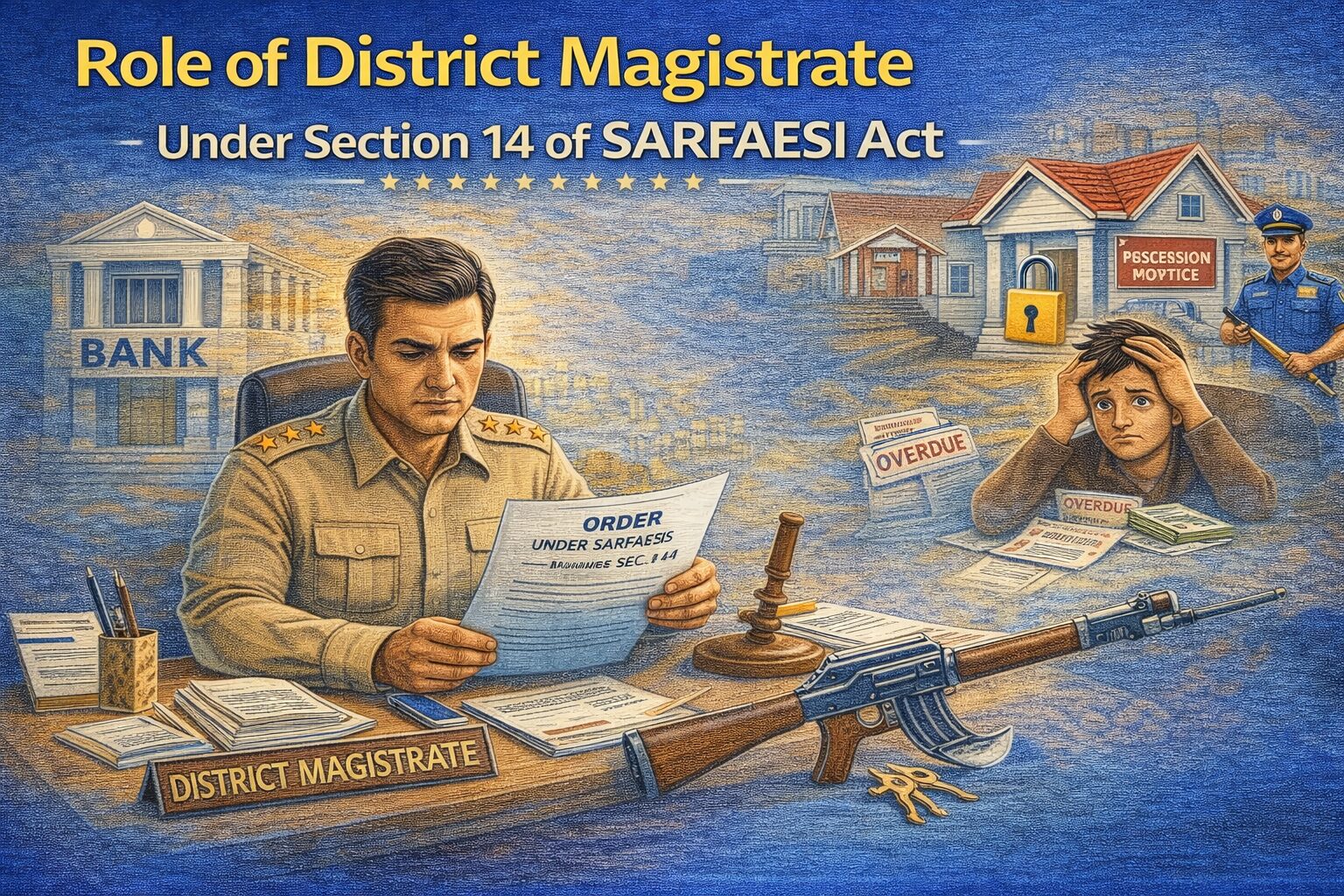
One of the most critical stages in SARFAESI proceedings is taking physical possession of the secured asset. When borrowers resist or are likely to resist possession, banks invoke Section 14 of the SARFAESI Act, 2002, seeking assistance from the District Magistrate (DM) or Chief Metropolitan Magistrate (CMM).
This article explains the role, powers, limitations, and legal duties of the District Magistrate under Section 14, an area frequently challenged before DRTs and High Courts.
Table of Contents
ToggleWhat Is Section 14 of the SARFAESI Act?
Section 14 empowers the District Magistrate or Chief Metropolitan Magistrate to:
Assist secured creditors in taking physical possession of secured assets, and
Provide police or administrative assistance where required
👉 Section 14 is an execution mechanism, not an adjudicatory process.
When Is Section 14 Invoked by Banks?
Banks approach the District Magistrate when:
Symbolic possession has already been taken under Section 13(4), and
The borrower refuses to hand over physical possession, or
Resistance or obstruction is anticipated
⚠️ Section 14 is not invoked at the demand notice stage.
Nature of the District Magistrate’s Role
Administrative, Not Judicial
The District Magistrate:
Does not decide disputes between borrower and bank
Does not examine merits of the loan transaction
Does not adjudicate borrower objections
The role is strictly administrative and ministerial.
Mandatory Requirements Before Passing Section 14 Order
Before granting assistance, the District Magistrate must be satisfied that the secured creditor has complied with statutory requirements.
Affidavit by the Authorized Officer
The bank must file an affidavit confirming:
The loan is a secured debt
The account is classified as NPA
Demand notice under Section 13(2) was issued
Objections under Section 13(3A) were considered
Measures under Section 13(4) were taken
The asset is not exempt (e.g., agricultural land)
👉 The DM must apply his mind to these declarations.
What the District Magistrate Can Do
Under Section 14, the District Magistrate may:
Pass an order authorising possession
Direct police assistance
Appoint an officer (Advocate Commissioner / Tahsildar)
Fix a date for taking possession
What the District Magistrate Cannot Do
The District Magistrate cannot:
Decide borrower-bank disputes
Grant time to borrower for repayment
Modify SARFAESI measures
Stay or suspend SARFAESI proceedings
Any such action exceeds jurisdiction.
Importance of “Application of Mind” by DM
Courts have consistently held that:
Section 14 orders must not be mechanical
The DM must record satisfaction based on the affidavit
Rubber-stamp orders are legally vulnerable
⚠️ Mechanical orders are frequently set aside by DRTs and High Courts.
Borrower’s Rights Against Section 14 Orders
Borrowers:
Cannot object before the District Magistrate
Cannot seek a hearing as a matter of right
However, borrowers can:
Challenge illegal Section 14 orders before DRT under Section 17
Approach High Court in cases of jurisdictional abuse
Common Grounds to Challenge Section 14 Proceedings
No valid NPA classification
Demand notice not served
Objections under Section 13(3A) ignored
Agricultural land proceeded against
Mechanical or non-reasoned DM order
Police Assistance Under Section 14
Police assistance:
Is meant only to facilitate possession
Cannot be used to intimidate or harass borrowers
Must strictly follow the DM’s order
Excessive force or deviation is actionable.
Section 14 and Borrower Remedies Before DRT
Once possession is taken with DM’s assistance:
Borrowers can file Section 17 application before DRT
DRT can:
Set aside possession
Restore possession
Declare Section 14 action illegal
DRT remains the primary remedial forum.
Practical Guidance for Borrowers
Act immediately after symbolic possession
Do not wait for police action
Collect copies of Section 14 order
Examine affidavit and DM satisfaction
Approach DRT promptly
Conclusion
The District Magistrate under Section 14 of the SARFAESI Act plays a crucial but limited role. While empowered to assist banks in taking physical possession, the Magistrate must ensure strict statutory compliance. Section 14 is not a blank cheque—it is a regulated administrative safeguard, and misuse of this power is legally challengeable.
FAQs
Q. Can a borrower be heard by the District Magistrate?
No. Borrower remedies lie before the DRT.
Q. Can Section 14 be invoked without symbolic possession?
Generally no. Symbolic possession precedes physical possession.
Q. Can a Section 14 order be challenged?
Yes, before the DRT or High Court on limited grounds.