

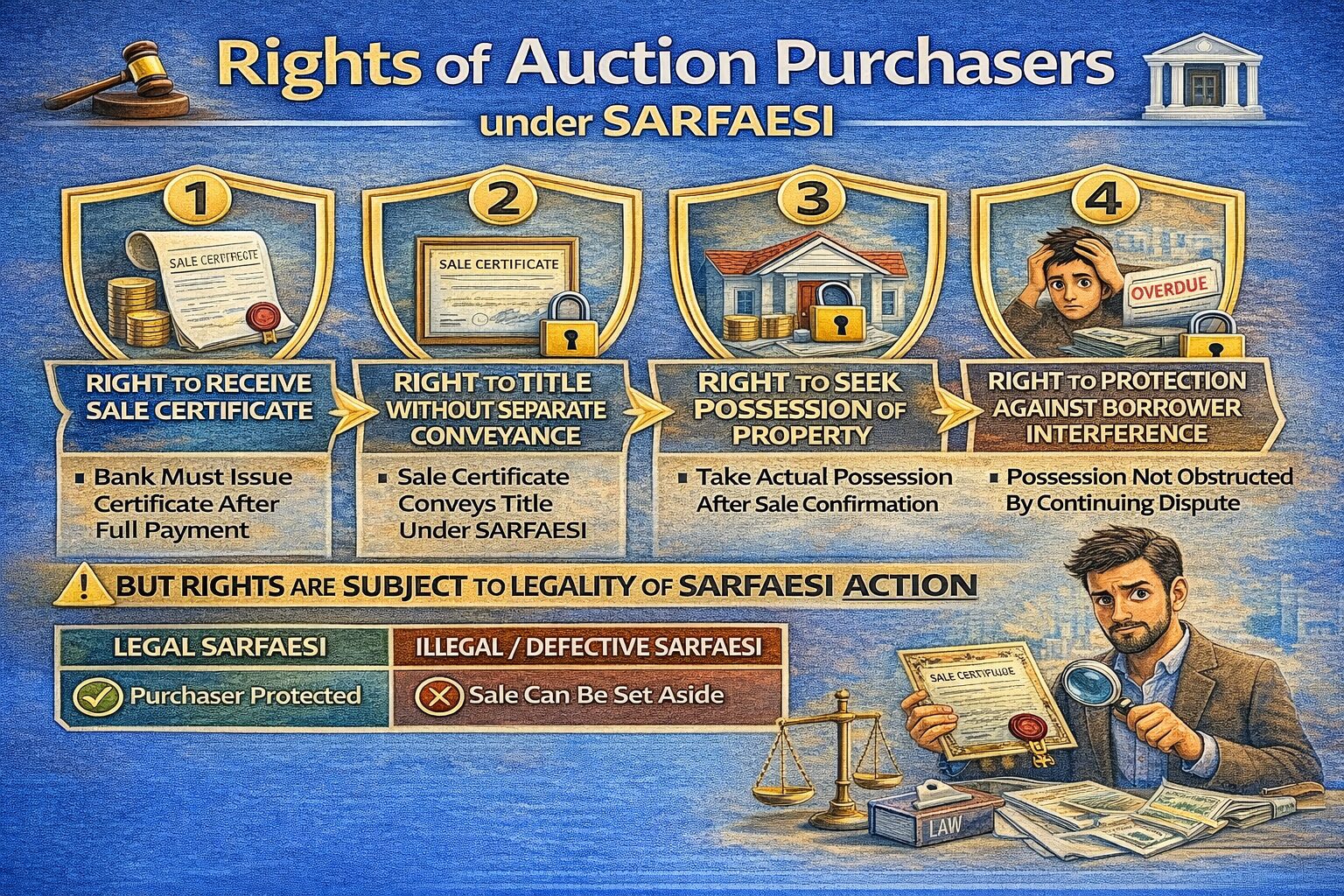
SARFAESI auctions attract investors, end-users, and speculators due to comparatively lower prices and faster title transfer. However, an auction purchaser under the SARFAESI Act, 2002 does not acquire absolute immunity merely by being the highest bidder. The purchaser’s rights are statutory, conditional, and subject to procedural legality.
This article explains the rights of auction purchasers under SARFAESI, the extent of legal protection available, and the risks involved.
Table of Contents
ToggleWho Is an Auction Purchaser under SARFAESI?
An auction purchaser is a person who:
Successfully bids in a SARFAESI auction conducted by a secured creditor
Complies with payment conditions
Receives a Sale Certificate under Rule 9 of the Security Interest (Enforcement) Rules, 2002
The purchaser derives title not from the borrower, but through statutory enforcement by the secured creditor.
When Do Rights of Auction Purchaser Arise?
Auction purchaser’s rights crystallise only after:
Lawful possession by the bank
Valid sale notice
Conduct of auction as per rules
Payment of full consideration
Issuance of sale certificate
👉 Mere participation or highest bid does not confer enforceable rights.
Key Rights of Auction Purchasers under SARFAESI
1. Right to Receive Sale Certificate
Once the purchaser:
Pays the entire bid amount within prescribed time
The bank must:
Issue a Sale Certificate
This certificate is the primary title document.
2. Right to Title Without Separate Conveyance
Under SARFAESI:
No separate sale deed is required
Sale certificate itself conveys title
Registration and stamp duty depend on State law, but title flows from statute, not contract.
3. Right to Seek Possession of Property
After sale confirmation, the auction purchaser can:
Seek actual possession of the property
If the borrower or occupant resists, assistance may be sought through:
The secured creditor
Magistrate proceedings
4. Right to Protection Against Borrower Interference
Borrowers:
Cannot obstruct possession merely by disputing debt
Cannot re-enter once possession is lawfully handed over
However, this protection exists only if the auction is legally valid.
Important Limitation on Auction Purchaser’s Rights
Rights Are Subject to Legality of SARFAESI Proceedings
Auction purchasers often assume:
❌ Once sale certificate is issued, title is unquestionable
✔ In law, auction purchaser’s rights are co-terminus with legality of SARFAESI action.
If:
Possession was illegal
Sale notice defective
Valuation flawed
Borrower’s statutory rights violated
👉 Entire auction can be set aside, affecting purchaser’s title.
Borrower’s Challenge vs Auction Purchaser’s Protection
| Situation | Effect on Purchaser |
|---|---|
| SARFAESI procedure strictly followed | Purchaser protected |
| Serious procedural violations | Sale can be set aside |
| DRT sets aside SARFAESI action | Purchaser loses title |
| Minor irregularities | Courts may protect purchaser |
Courts often balance:
Borrower’s statutory rights
Bona fide purchaser’s equities
Is Auction Purchaser a Bona Fide Purchaser?
An auction purchaser is not automatically treated as a bona fide purchaser without notice.
Purchasers are expected to:
Conduct due diligence
Verify SARFAESI compliance
Check pending litigation
Failure to do so weakens equity claims.
Common Risks for Auction Purchasers
Borrower challenge before DRT
Stay orders after auction
Delay in physical possession
Encumbrances not disclosed
Defective Section 14 proceedings
SARFAESI auctions are high-return but high-risk.
Remedies Available to Auction Purchasers
Auction purchasers may:
Defend sale before DRT
Seek possession through secured creditor
Claim refund with interest if sale is set aside
Challenge arbitrary cancellation by bank
However, no independent SARFAESI proceeding lies at purchaser’s instance—rights flow through the secured creditor.
Practical Due-Diligence Checklist for Auction Purchasers
Before bidding:
Verify Section 13(2) & 13(4) compliance
Check possession notice & publications
Confirm valuation & reserve price
Ascertain pending DRT or High Court cases
Inspect property physically
After auction:
Ensure timely issuance of sale certificate
Seek possession without delay
Common Myths Among Auction Purchasers
❌ SARFAESI auction gives “court-free” title
❌ Sale certificate cannot be challenged
❌ Borrower has no remedy after auction
✔ In reality:
SARFAESI sales are judicially reviewable
Borrower remedies continue
Purchaser protection depends on legality
Conclusion
Auction purchasers under SARFAESI enjoy statutory rights, but not statutory immunity. Their title is strong only if the underlying SARFAESI proceedings are legally flawless. A SARFAESI auction is therefore not merely a financial transaction, but a legal exercise demanding careful diligence.
For purchasers, prudence before bidding is far more valuable than litigation after purchase.
FAQs
Q. Can a SARFAESI auction purchaser be dispossessed later?
Yes, if the auction is set aside by DRT or Court.
Q. Is sale certificate conclusive proof of title?
It conveys title, but subject to legality of proceedings.
Q. Can auction purchaser directly approach DRT?
Generally no, except in limited defensive circumstances.