

Introduction
Generative Artificial Intelligence (GenAI) is rapidly transforming the global technological and creative landscape. From medical diagnostics to climate modelling, from content creation to governance, GenAI promises unparalleled efficiency and innovation. However, its exponential growth has also triggered a complex debate: How should copyright law respond to AI systems that are trained on massive volumes of human-created, copyrighted materials?
Table of Contents
ToggleIndia, with its strong cultural heritage, thriving digital ecosystem, and growing AI capabilities, stands at an important crossroads. The challenge is clear — ensuring AI progress without compromising the rights and livelihoods of human creators who supply the very content on which AI models depend.
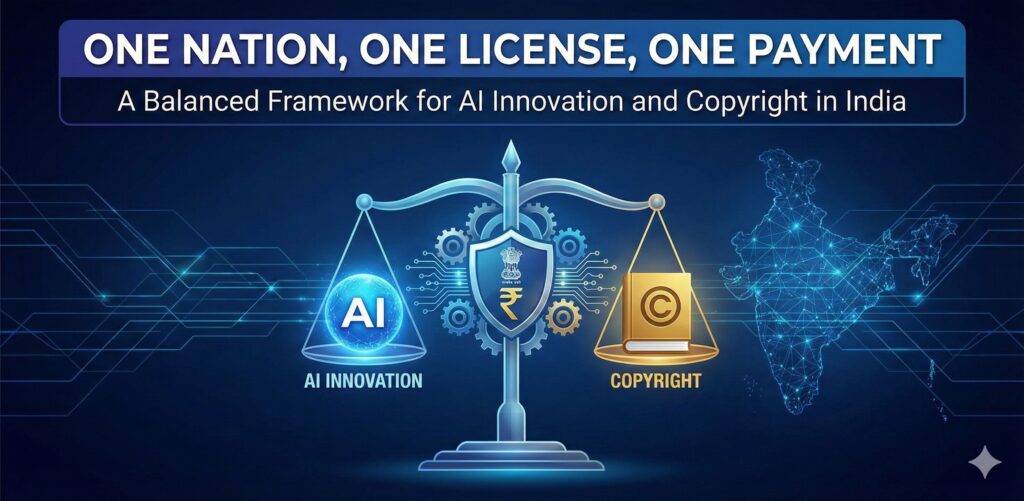
Recognizing this, the Department for Promotion of Industry and Internal Trade (DPIIT) constituted a committee to examine copyright issues raised by GenAI and propose a framework that balances technological advancement with creators’ rights. The result is the proposal of a hybrid regulatory architecture, popularly captured by the phrase: ONE NATION • ONE LICENSE • ONE PAYMENT
This article summarises the key issues, findings, and proposals from the Working Paper and explores their importance in shaping India’s AI future.
India’s AI Ecosystem: A Rapidly Growing Landscape
In recent years, India has emerged as a major player in global AI development:
The IndiaAI Mission, with an allocation exceeding ₹10,300 crore, seeks to build sovereign compute capacity, indigenous foundation models, and AI-ready datasets.
Indian startups are active in GenAI innovation, supported through accelerator programs, scholarships, and GPU infrastructure.
Initiatives like AIKosh, the national dataset platform, and IndiaAI FutureSkills aim to democratize data and education.
India will host the Global AI Impact Summit 2026, reflecting its rising influence on the world’s AI governance landscape.
At the same time, the creative economy — spanning film, music, literature, digital art, folk traditions, and regional storytelling — remains a crucial pillar of India’s identity and economic growth. It contributes billions to GDP and employs millions, especially in the informal sector.
Thus, India must build an AI regulatory model that respects and rewards human creativity while enabling technological progress.
The Copyright Challenge: Training AI on Human-Created Works
Modern GenAI systems are trained on millions to billions of data points, including:
books, news articles, poems
movies, songs, lyrics
paintings, photographs
software code
publicly available webpages
Much of this material is copyrighted, and today AI developers often use it without licence or compensation.
Key legal questions arise:
Does AI training constitute copyright infringement?
Training requires copying and storing works — sometimes temporarily, often repeatedly — which may fall under the exclusive rights of the copyright holder.Do existing “fair dealing” exemptions under Section 52 of the Copyright Act cover AI training?
They currently do not, as Indian law permits fair dealing only for private research, criticism, review, or reporting of current events.What about international practices?
Jurisdictions differ — some permit text and data mining exceptions; others do not. But each faces similar tension between innovation and creator rights.Should rightsholders be allowed to “opt out” of AI training?
This favors large players but leaves small creators vulnerable and unaware.How can India ensure AI access to high-quality datasets without undermining human creativity?
The DPIIT Committee evaluated global trends, local stakeholder feedback and ongoing litigations — including ANI v. OpenAI, India’s first major AI copyright case.
What Stakeholders Said
AI/Tech Industry
Requested a blanket exemption for Text and Data Mining (TDM), without needing licences.
Some supported a TDM exception with an opt-out mechanism.
Content Creators & Industries
Strongly opposed TDM exceptions.
Demanded mandatory licensing and royalty-based compensation.
Committee’s Finding
A majority concluded that:
A broad TDM exception would undermine copyright and harm India’s creative economy.
An opt-out model would be ineffective, create imbalance, and fail to protect small creators.
Negotiating individual licences with AI developers would be impractical, slow, and expensive.
Thus, the Committee developed a hybrid model that ensures access for AI developers while guaranteeing payment to creators.
The Proposed Hybrid Model: ONE NATION, ONE LICENSE, ONE PAYMENT
The recommended model introduces a Mandatory Blanket License for all AI developers in India.
KEY FEATURES OF THE MODEL
1. Mandatory Blanket Licence for AI Training
All lawfully accessed copyrighted content may be used for AI training as a matter of right, without individual negotiation with creators.
This ensures:
lower entry barriers for startups
reduced compliance hassle
universal dataset access
faster AI innovation
2. A Central Royalty Collecting Entity
A new non-profit body, Copyright Royalties Collective for AI Training (CRCAT), will be formed by copyright societies and Collective Management Organisations (CMOs).
It will:
collect licence fees from AI developers
distribute royalties to creators and copyright owners
maintain a registration mechanism for works
ensure transparent audit and grievance redressal
Both members and non-members of copyright societies can receive royalties.
3. Royalties Based on AI Revenue
AI developers will pay a percentage of their revenue generated from AI systems that were trained on copyrighted content.
A government-appointed committee will:
periodically set royalty rates
ensure fairness
conduct impact assessments
4. No Opt-Out for Rightsholders
To maintain broad and representative datasets, copyright owners cannot exclude their works from being used for training.
However, they are guaranteed:
statutory remuneration rights
transparent payment mechanisms
judicial review over royalty rates
5. Benefits of the Hybrid Model
The model ensures:
For Creators
guaranteed compensation
protection of rights
exposure to AI-driven global markets
For AI Developers
easy access to content
reduced licensing friction
innovation at scale
For India
a level playing field for all players
reduced bias and hallucinations due to richer datasets
stronger domestic AI capacity
sustained creative economy
Why This Balance Matters
India is witnessing unprecedented adoption of AI tools. With India being OpenAI’s second-largest market (and potentially the largest), creators deserve a fair share of the value generated from their work.
If AI continues to train on human-created works without rewarding creators:
the creative ecosystem may weaken
diversity and originality in content may decline
AI may end up training on AI-generated content, lowering quality over time
A strong copyright framework is essential not only for protecting cultural heritage but also for sustaining long-term AI quality.
Conclusion
India stands at the edge of a transformative moment. The convergence of:
a vibrant creative economy
a fast-growing AI sector
government-backed AI infrastructure
global leadership in digital governance
positions the country to shape an innovative yet inclusive AI future.
The “One Nation, One License, One Payment” model represents a balanced approach that respects both the creator and the innovator. It aims to create a sustainable ecosystem where AI advances in harmony with human creativity — ensuring that as India becomes an AI powerhouse, its cultural and creative foundations remain strong, valued, and protected.