

Table of Contents
ToggleIntroduction
The Union Budget 2026–27 has proposed the creation of a new cadre of trained paraprofessionals, termed “Corporate Mitras”, aimed at supporting Micro, Small and Medium Enterprises (MSMEs) in meeting their compliance and regulatory requirements. The stated objective is to reduce the compliance burden on MSMEs, improve ease of doing business, and widen formalisation of small enterprises.
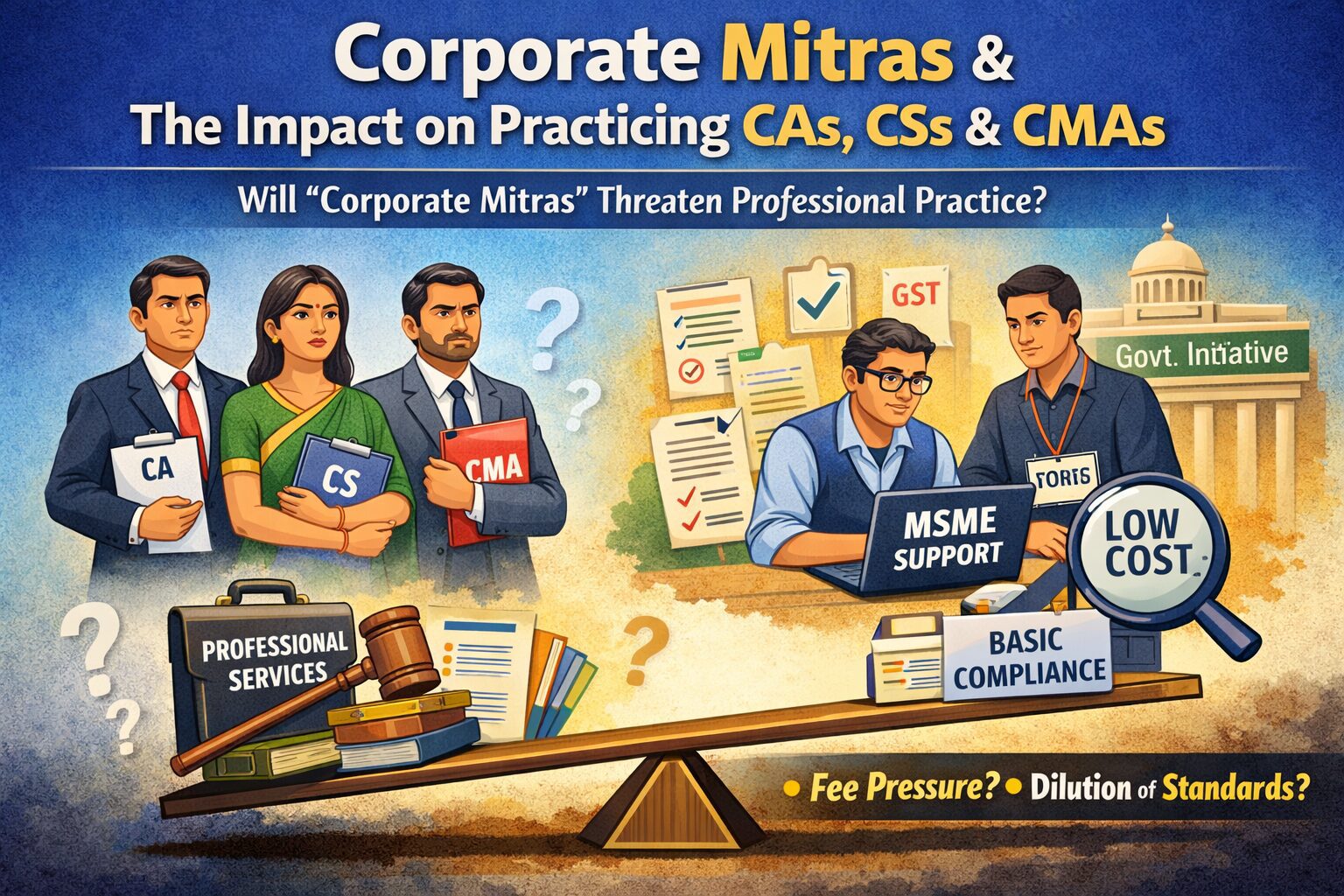
While the intention appears well-meaning, the proposal has triggered serious apprehension among practicing Chartered Accountants (CAs), Company Secretaries (CSs), and Cost and Management Accountants (CMAs). These professionals have traditionally been the backbone of MSME compliance in India. The key question therefore arises:
Does the Corporate Mitra framework pose a threat to practicing professionals, or does it merely reshape the compliance ecosystem?
Understanding the “Corporate Mitra” Concept
As per the Budget announcement, Corporate Mitras are envisioned as:
Trained paraprofessionals
Providing hand-holding support to MSMEs
Assisting in routine and basic compliance requirements
Acting as a bridge between small businesses and the regulatory system
Though detailed guidelines are awaited, it is clear that Corporate Mitras are not full-fledged professionals regulated by statutory councils, but individuals trained through government-supported programs.
Traditional Role of Practicing CAs, CSs and CMAs in MSME Sector
For decades, MSMEs have relied heavily on practicing professionals for:
Incorporation and structuring
ROC, GST, Income-tax and labour law compliances
Audit, certification and attestation
Advisory on governance, funding and restructuring
Representation before authorities
For many small and mid-size firms of CAs, CSs and CMAs, MSME compliance work forms a significant portion of recurring revenue.
Key Concerns for Professionals in Practice
1. Erosion of Entry-Level and Routine Work
Routine compliance work—such as form filing, returns, basic documentation and reminders—has traditionally been the starting point of professional engagement with MSMEs.
If Corporate Mitras are authorised to handle:
Basic filings
Periodic returns
Documentation support
then entry-level compliance work may shift away from professionals, especially in cost-sensitive MSMEs.
2. Fee Pressure and Commoditisation of Compliance
With the availability of government-supported paraprofessionals:
MSMEs may expect lower professional fees
Compliance may be perceived as a low-skill, low-value activity
Professionals may face pressure to reduce pricing to compete
This could accelerate the commoditisation of compliance services, particularly in Tier-II and Tier-III cities.
3. Risk of Dilution of Professional Standards
Statutory professionals are bound by:
Rigorous education and examinations
Ethical codes and disciplinary mechanisms
Professional liability and accountability
Corporate Mitras, unless similarly regulated, may:
Lack depth of legal understanding
Commit procedural errors
Expose MSMEs to compliance risks
Ironically, errors by Mitras may eventually land back on professionals for rectification, increasing liability without corresponding remuneration.
4. Impact on Small and Sole Practitioner Firms
Large firms may pivot easily towards:
Advisory
Litigation
Transaction support
However, small and sole practitioners, especially those primarily serving MSMEs, are likely to feel the maximum impact, as:
Their practice is compliance-heavy
Margins are already thin
Client retention depends on end-to-end service offerings
Is It a Complete Threat? A More Balanced View
Despite concerns, the proposal does not necessarily spell doom for professionals.
1. Boundary of Authority Still Lies with Professionals
Certain functions cannot be outsourced to paraprofessionals, such as:
Statutory audits
Certifications and attestations
Legal opinions
Representations before tribunals and authorities
The final responsibility and sign-off will continue to rest with licensed professionals.
2. Potential to Act as an Extended Workforce
If structured wisely, Corporate Mitras could:
Act as compliance facilitators under professional supervision
Reduce clerical and follow-up burden
Improve compliance reach in underserved areas
Professionals could leverage Mitras as execution support, while focusing on higher-value work.
3. Shift from Compliance to Advisory
The development reinforces an unavoidable reality:
Pure compliance work is no longer the future of professional practice.
Professionals who evolve into:
Strategic advisors
Governance consultants
Transaction and restructuring experts
Risk and compliance managers
will remain indispensable.
Way Forward for Practicing Professionals
1. Upskilling and Specialisation
Professionals must move beyond routine filings into:
Complex advisory
Sector-specific expertise
Litigation and representation
2. Client Education
MSMEs must be educated that:
Compliance is not just filing
Errors can lead to penalties, disqualification and prosecution
Professional oversight is non-negotiable
3. Engaging with Policymakers
Professional institutes must:
Seek clarity on scope of Corporate Mitras
Ensure no overlap with regulated professional functions
Advocate accountability and supervision mechanisms
Conclusion
The introduction of Corporate Mitras under Union Budget 2026–27 represents a structural shift in the compliance ecosystem, not an outright replacement of professionals. While it does pose challenges—especially for routine compliance-centric practices—it also presents an opportunity for transformation.
Practicing Chartered Accountants, Company Secretaries and Cost Accountants who adapt, upskill and reposition themselves as trusted advisors rather than mere compliance vendors will continue to play a central role in India’s MSME growth story.
In essence, the proposal is less a threat to the profession and more a wake-up call for its evolution.